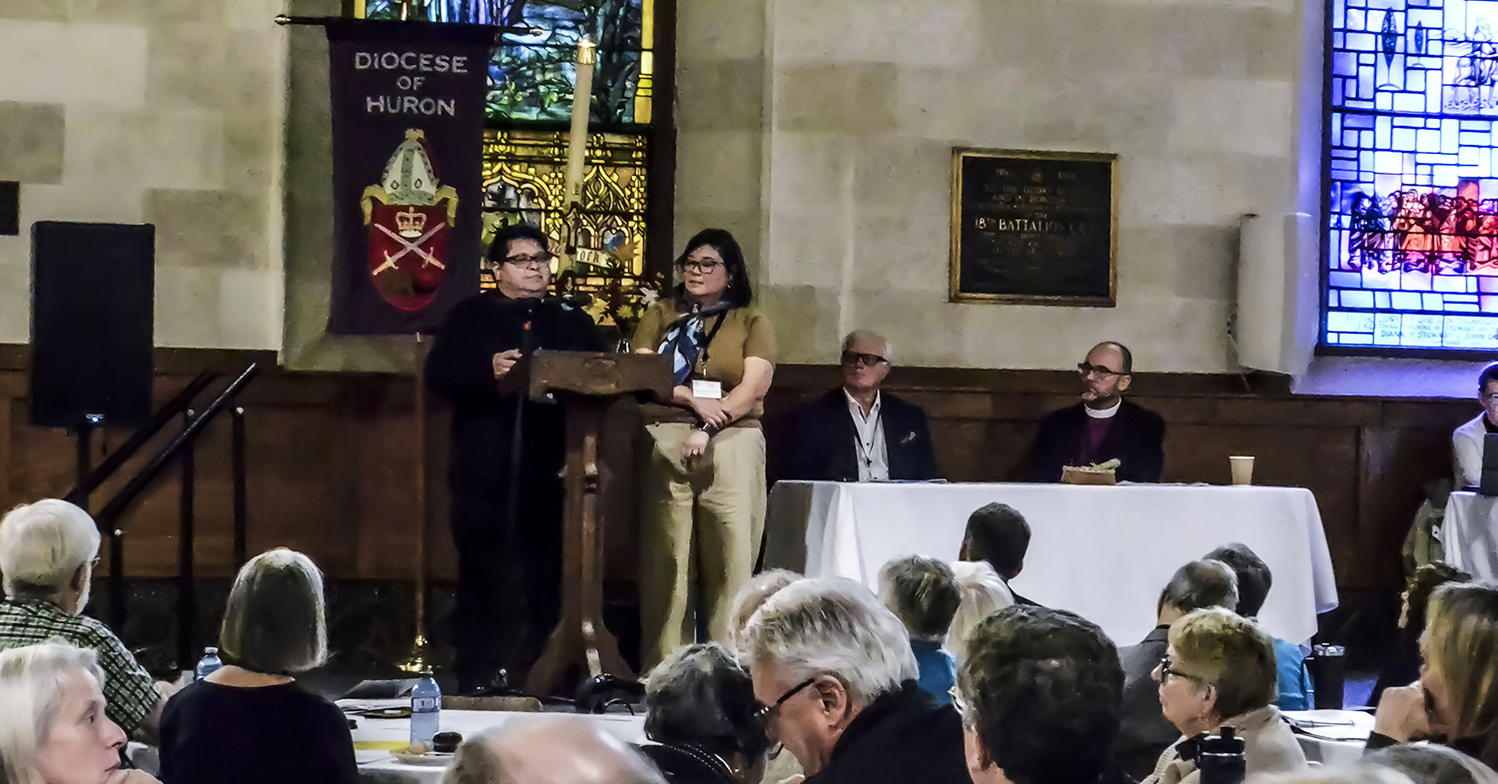
Ven. Rosalyn Elm (left) and Rev. Hana Scorrar during Indigenous Ministry presentation in St. Paul's Cathedral, October 25, 2025. Photo: Rebekah Lemon
By Ven. Rosalyn Kantlaht'ant Elm
IT IS TIME for us to describe the ways in which ministry is changing in our context, to pay attention to how we are rebuilding in pastoral ways and in liturgical ways. It may not look the same for you, but this is something we must do to serve our people.
If we can describe these ways in which ministry is changing for us, I think we will be a lot better off.
One of the things that we do talk about across Turtle Island in Indigenous ministries – something that was a big part of our Sacred Circle or our General Synod – was the idea of resurgence. Resurgence in our Indigenous ways of knowing and being ways of identifying ourselves by our environment, whether it is mountains, whether it is the big waters, whether it is forests, whether it is tundra, whether it is ice and snow.
To describe our resurgence, we have made many more idioms around our governance structure. We have come to understand that the idioms of Anglican polity are changing, and we are witnessing that here especially in Indigenous ministries. When I say “vestry” in our Indigenous communities, the idea of vestry looks very different from the idea of vestry that you might know in the various parishes across this diocese. And that's okay. But the ability to describe it is so important to our mission in ministry plan.
Creating relationships, creating new ways of doing ministry doesn't happen overnight. It's slow. And one of my laments to my colleagues is that I have no idea what's happening. All I can do is observe it. All I can do is make note of it. I'm not really sure what to do. I am looking for wisdom.
One of the things that we are moving towards is having a mission field, because we have a ministry team that is not paid but goes on and off, on and off and rubber banding throughout. We have also helpers that are coming in taking up here and there here and there here and there. So, it's not a parish structure in the same way that you might know. Instead, it is a mission field.
And I know mission is a bad word, but Hannah is always here to change that definition. Speaking of changing definitions, in the way that we do ministry, what we are moving away from is the idea of conversion and into the idea of revelation. Not to say that conversion is not important. I'm not saying that at all. But instead for our context, in order for things to change, Jesus reveals himself to the people, and we are there for the care to be the hands and feet. They have received a revelation of some sort. They know that in their hearts. We see it on their faces. So we are there to serve that revelation. And whatever happens next is of course the Spirit's work and not ours.
Our call to you as indigenous ministries, that you can glean of the learnings that we present, is to be able to describe your ministries. Because this isn't just for us. This is happening to you.
Both lay ministers, deacons and priests are experiencing the need for healing, the need for confession and absolution; that we witness the revelation that is happening in their hearts and in their minds.
We do it scared. Sometimes we're not prepared. We don't always possess the perfect knowledge or the right words to say. But we do it because we have this calling, this vocation of serving others, to just describe what we do, to talk about what we do with each other, with our parishioners so that they might go out too. It will change the way that we live in our discipleship. That is our call to you to describe the miracles occurring around you.
Last night we witnessed the idea of medicines as sacrament as Bishop Todd gave his reflection on bestowing the medicines to the deaneries. In many ways what has to happen is that you give the medicines to us. The church has to give the medicine to us for that healing. There is another way around. We are giving the medicines to you for your healing, for your understanding.
In our many conversations, we talked of these things. Healing is one of our oldest languages of faith. Long before the church named sacrament, Indigenous peoples have already recognized the world, the earth itself as sacred. The land, the waters, the fish, the animals, they are teachers. Waters are healers. Plants are relatives. They are bringing these gifts to life. So, to receive medicine then is not merely to take something from the earth, but to enter a relationship with it. In that relationship, grace becomes tangible.
For us as Anglicans, sacrament is an outward invisible sign of an inward and spiritual grace. The waters of baptism, the bread and wine of Eucharist - elements through which God's invisible love becomes manifest.
But what if we looked at these a little wider? What if we could see these sacraments as medicines, as healing? And we do, because they sustain and heal us – material signs through which God's creative and restorative power is made known. So, when our beekeepers or our pipe carriers create medicine bundles, or even when our nurses and doctors offer vaccine, when a family gathers around a parishioner or an elder with healing words, or with tea or with herb – these are the moments in which grace becomes embodied. So healing is not a biological process. It is a spiritual communion between the Creator and Creation. So, the medicines are not venerated in this way, but they are carriers of this divine generosity. They remind us that creation is not an inert matter but instead it is living, carrying on the prayers, carrying the prayers, carrying the healing messages, mediating the presence of God.
Our scripture tells us that healing and holiness are inseparable. Jesus’ ministry is filled with healing and restoration. Blood, saliva, hands, breath. These acts are sacramental. He uses these materials to restore relationship and reveal divine compassion. God's healing power is not confined to walls, not confined to flagons, not confined to picks, not confined by anything. It flows like rivers, flows like roots and through human hands. For us as Indigenous people, for Indigenous Anglicans, or rather Indigenous people who are Anglican, this innovation of looking at medicines as sacraments is not something new. For us, it's a going back and remembering; it's a return to the truth of the land and earth as our first altar, Jesus as our first body given by a woman.
Today, medicine as a sacrament is also a call to justice. If this land is a carrier of grace, then to poison it is to desecrate divine healing. It has become our theological pain. So together when we receive medicine, whether it is through Eucharist and ceremony, or ceremony with hospital care sustenance, we are invited to do so with a sacred, with a reverence to give thanks, to remember that healing is not a private transaction but a shared act. Our Creator moves through earth and body through prayer and science through ancient ceremony and modern care.
Ven. Rosalyn Kantlaht'ant Elm is Archdeacon for Reconciliation and Indigenous Ministry in the Diocese of Huron.
Edited and adapted for print from a video presentation available on the diocesan website.
Source: https://www.diohuron.org/podcasts/media/2025-10-15-186th-synod-of-the-diocese-of-huron